 It looks nothing but a pile of bricks, but it is the significance that counts because this ruined structure used to be a platform (called bema by the Hebrews) which played an important role on the lives of ancient people of Corinth. Just imagine the phrases on the bible " a reading from the book of Saint Paul to the Corinthians", then it was at this bema where apostle Paul actually stood and spoke, and did his preaching to the Corinthians. And on 4th May 2001, Pope John Paul II and Archbishop Christodoulos (archbishop of Athens and all Greece) set their memorable meeting at this very significant place. (Corinth, Greece / 2011)
28 October 2011
The Bema at Corinth
It looks nothing but a pile of bricks, but it is the significance that counts because this ruined structure used to be a platform (called bema by the Hebrews) which played an important role on the lives of ancient people of Corinth. Just imagine the phrases on the bible " a reading from the book of Saint Paul to the Corinthians", then it was at this bema where apostle Paul actually stood and spoke, and did his preaching to the Corinthians. And on 4th May 2001, Pope John Paul II and Archbishop Christodoulos (archbishop of Athens and all Greece) set their memorable meeting at this very significant place. (Corinth, Greece / 2011) 
14 August 2011
Bouboulina Museum
 This private museum in Spetses is catered in a 300-year old house of heroine Laskarina Bouboulina herself. The museum is a home to different revolutionary documents, books, maps and weapons; collection of portraits, engravings, embroideries, household furnishings and other personal belongings of the heroine. Trivia : Laskarina Bouboulina - the strongest Greek heroine, is the only women admiral in the world naval history. (Spetses, Greece / 2011)
24 July 2011
Lycabettus Hill
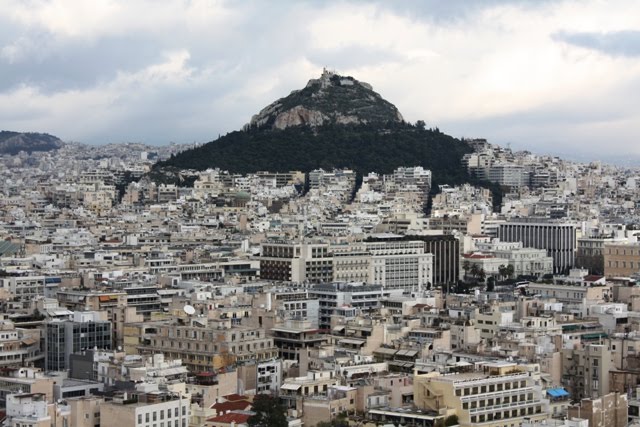 Lycabettus hill is a Cretaceous limestone hill in Athens that rises 277 meters above sea level. The hill is a popular tourist destination and can be reached by a car or by a long and winding walk. But the best thing to ascend the hill is by the use of spectacular funicular railway inside the tunnel that climbs the hill from the lower terminal. Whatever way one prefers, there is a reward at the top - a 360 degree view of the city below. The hill caters an open air theatre and restaurant, and on its peak is a 19th century chapel of St. George. (Athens, Greece / 2011)
17 April 2011
The Pantheon
 The Pantheon is cylindrical in shape and is roofed with a dome. The facade is designed with rows of huge granite corinthian columns. The top of the dome has a large opening which is the only source of light. At 43.4 meters, the height of the dome and the internal diameter of the structure are the same. It was originally built as temple of pagan gods, but was later converted into church. The building now contains the tombs of famous artist Raphael and some of Italian kings. With its ecclesiastical interior design and geometic pattern, it became one of the best preserved buildings in Rome. (Rome, Italy / 2009)
10 April 2011
Spanish Steps
 Spanish Steps or Scalinata della Trinita dei Monte is a monumental stairway in Rome that stands at the steep slope between the Piazza de Spagna at the bottom, and the church of Trinita dei Monte on top. At the base is the early Baroque fountain, called Fontana della Barcacia. Completed in 1725, the steps formed a symbolic link between the king of Spain whose embassy was laid at the base of the hill, and the catholic church papacy which had been stationed in Rome. Designed with 138 steps which gradually widen down the hill in the shape of a fan, the staircase is the widest in Europe. Nowadays, it is a popular tourist spot in Rome. (Rome, Italy / 2009)
05 March 2011
Arc de Triomphe
 Arc de Triomphe stands at the center of Place de Gaulle on the western end of Champs Elysees in Paris. It stands 50m in height, 45m long and 22m wide. The monument has two vaults. Beneath its vaults lies the "tomb of unknown soldiers" from World War I. It also honors those who fought and died for France in the French Revolution and Napoleonic wars, with the names of all French victors and generals inscribed in its surface. The arch is the second triumphal arch in existence and is one of the most famous monuments in Paris. (Paris, France / 2010)
27 February 2011
Chateaux de Versailles


The castle is one of the most visited chateaux in France and one of the largest palaces in the world. It is the grand example of French architecture. The castle has over 2000 windows, 700 rooms, over 1200 fireplaces, 67 staircases. In 1789, this magnificent palace was converted into museum of French history. Aside from the "Hall of Mirroros" and the lavishly decorated King's bedroom, the museum also caters paintings, sculptures, tapestries and furnitures. The Versailles garden has 1300 units of fountain which uses water coming from the Seine River. (Versailles, France / 2010)
20 February 2011
Place de Concorde
 This 8-hectare Place de Concorde is the largest public square in Paris. Originally named Place Louis XV, the square was designed originally for the purpose of showcasing equestrian statue of the king. The construction of the square began in 1754 and was completed in 1763. Several decades after its construction, the square became a focal point for the bloodiest French revolution. Following the revolution, the square suffered several transformations and changes of names until it was finally called Place de Concorde - symbolizing the troubled era and the hope for a better future. In the middle of the square is a more than 3200 year old obelisk, standing 23 meters tall, weighing more than 220 tons and is covered with heiroglyphs. (Paris, France / 2010)
13 February 2011
Paris Disneyland
 Located within 4,800 acres of land in Marne-la-Velle (a town in the eastern suburb of Paris), Disneyland Paris is a holiday and recreational resort with two theme parks, entertainment district, and seven Disney-owned resort hotels. Following the opening at Tokyo, it was the second Disney resort to open outside America. From its opening in 12 April 1992 to 15 August 2008, Disneyland Paris gathered 200 million guests, making it the most visited attraction in Europe. (Marne-la-Velle, France / 2010)
06 February 2011
Battleship "G. Averof"

This 140 meter l.o.a. battleship-turned-museum was the most important and impressive surviving naval vessel in the history of Hellenic navy, and is the world's only surviving heavily armoured cruiser. Commisioned in 1911, this ship remained active in service for 44 years and survived four different wars in the first half of 20th century. In 1985, she was towed to her permanent berth at Faliron bay, and is now serving as a naval museum. (Piraeus, Greece / 2010)
16 January 2011
White Tower Of Thessaloniki
 This cylindrical tower (23m dia x 27m high)with a turret (12m dia x 6m high) was once a notorious prison cell during Ottoman rule. Each of the 6 floors has been divided with several chambers, and can be accessed through spiral steps. Owing to countless victims of mass executions there, it was called "tower of blood" or "red tower". When Greece got control of the city in 1912, the tower was whitewashed as a sign of cleansing and acquired its present name. Since then, the tower was substantially remodeled, and is now buff in color. Nowadays, it houses the museum of Thessaloniki's history. Standing at the waterfront boulevard, it becomes Thessaloniki's landmark and is now one of the city's leading attractions. (Thessaloniki, Greece / 2010)
14 January 2011
Royal Tombs Of Macedonia
 Discovered in 1977, these tombs underneath an earthen mound (approximately 10m high x 110m across), were the tombs of kings and royal dynasties of Macedonia, Greece. Of the particular note is the tomb of King Philip II, the Macedonian king and the father of Alexander the Great. In 1993, an underground building was constructed to protect the tombs and to serve as a museum for the treasures found in the mound. The larnax, the crown and the weapons (notably the shield) of King Philip II are among the finds being catered on the underground museum. (Vergina, Greece / 2010)
11 January 2011
Alexander the Great Monument
 Situated along the shore of Thessaloniki, this monument was erected to honor Alexander the Great, the Macedonian conqueror of ancient world. Trivia: Alexander the Great was a towering figure in ancient history. He was born in Pella, in the prefecture of Macedonia, Greece. He came close to conquer the entire civilized world during his time. His favorite horse "Bucephalus" is one of history's famous steeds. He died at the age of 33 at Alexandria (the city he founded and named for himself), Egypt. His golden coffin in Alexandria attracts travelers over the century. (Thessaloniki, Greece / 2010)
06 January 2011
Hagios Demetrios
 The church of Saint Demetrius or Hagios Demetrios is the main sanctuary dedicated to Saint Demetrius, the patron saint of Thessaloniki. It is a part of Palaeochristian and Byzantine monuments of Thessaloniki that was included at Unesco's World Heritage Site list in 1988. Inside the church is an unusual shrine, a hexagonal-roofed structure at one side of the nave and was made of silver. Inside the structure is a couch or bed. The church is the most significant symbol in the city. (Thessaloniki , Greece / 2010)
31 December 2010
Hagia Sofia
 Hagia Sofia or the church of Saint Sophia is one of the oldest churches in the city of Thessaloniki that still stands today. After seven or eight centuries as an orthodox church, it has been converted by Turks into mosque in 1585. After a fire in 1890, it was reconstructed in 1907 to 1910 and was re dedicated for Christian worship in 1912. The church is a part of the Palaeochristian and Byzantine Monuments of Thessaloniki on the list of World Heritage Sites by Unesco. (Thessaloniki, Greece / 2010)
30 October 2010
Eiffel Tower
 Being the tallest in Paris, this iron lattice tower has become the global icon in France. It is one of the most recognizable structures and single most visited paid monument in the world. The 324-meter tall tower was inaugurated on 31 March 1889. The metal structure weighs 7,300 tonnes while the entire structure including non-metal components is approximately 10,000 tonnes. The tower has three levels. The first and the second level can be ascended by stairs or a lift, but the third and highest level is accessible only by lift. Both the first and second levels feature restaurants. As a global landmark, Eiffel tower is featured in media including films, videos, and television shows. (Paris, France / 2010)
23 October 2010
Louvre Museum

Louvre museum was originally built as a 12th century fortress, then converted into royal palace in the 14th century, and then became a public museum at the end of 18th century. It is now one of the largest and most visited museums in the world. The museum contains the collections of antiquity, European paintings and sculptures, and other Roman, Egyptian , Greek and oriental work of arts. The most famous collection in the museum is the Leonardo da Vinci's Monalisa painting. The most recent addition to the Louvre was the construction of the glass pyramid in 1989 which functions as the museum's main entrance. The design of the glass allows the sunlight to come in on the underground floor. (Paris, France / 2010)
16 October 2010
Seine River
 Seine river is a major commercial waterway within the regions of Ile-de-France and Haute-Normandie. It is 776 km long with an average depth of 8 meters. About ten percent of its length is navigable by ocean-going vessels, sixty percent by commercial river boats and nearly whole of its length for recreational boating. Since Seine is centrally located in Paris, a boat tour with the famous Bateaux Mouches is a great adventure within the city. Along the cruise, the passengers can see Eiffel Tower, Notre Dame Cathedral, Alexander III Bridge, the Pont Neuf, Orsay Museum, Louvre Museum, Les Invalides and Napoleon's burial site. In 1991, the river banks of Siene in Paris (Rive Gauche and Rive Droite) were added to the list of World Heritage Sites in Europe. (Paris, France / 2010)
09 October 2010
Notre Dame Cathedral
 The cathedral of Notre Dame in Paris, though not the largest cathedral in the world, might be the most famous of all cathedrals. The cathedral was built in a new gothic style and became the prototype of the suceeding cathedrals in France. The construction took until 1345 before it was finally completed. The overwhelming building measures 128 m long, with two 69 m tall towers. The spire reaches 90 meters. The cathedral has several large rose windows with three wide portals on the frontal facade. This magnificent architecture was last restored between 1991 and 2001 to preserve its historical value. The site of the Notre Dame is the cradle of Paris and has always been the religious center of the city. (Paris, France / 2010)
26 September 2010
Herod Atticus Theater
 This stone theater structure built on the south slope of the Acropolis of Athens was originally a steep-sloped amphitheatre with a three-storey stone front and a wooden roof. It was built in 161 AD and was used as venue for musical concerts and festivals with a capacity of 5,000 persons. The audience stands and the stage were restored in 1950s using pentelic marble. In the present time, the structure is still in use for some important and remarkable events. (Athens, Greece / 2010)
Subscribe to:
Posts (Atom)