 This private museum in Spetses is catered in a 300-year old house of heroine Laskarina Bouboulina herself. The museum is a home to different revolutionary documents, books, maps and weapons; collection of portraits, engravings, embroideries, household furnishings and other personal belongings of the heroine. Trivia : Laskarina Bouboulina - the strongest Greek heroine, is the only women admiral in the world naval history. (Spetses, Greece / 2011)
 14 August 2011
Bouboulina Museum
This private museum in Spetses is catered in a 300-year old house of heroine Laskarina Bouboulina herself. The museum is a home to different revolutionary documents, books, maps and weapons; collection of portraits, engravings, embroideries, household furnishings and other personal belongings of the heroine. Trivia : Laskarina Bouboulina - the strongest Greek heroine, is the only women admiral in the world naval history. (Spetses, Greece / 2011) 
24 July 2011
Lycabettus Hill
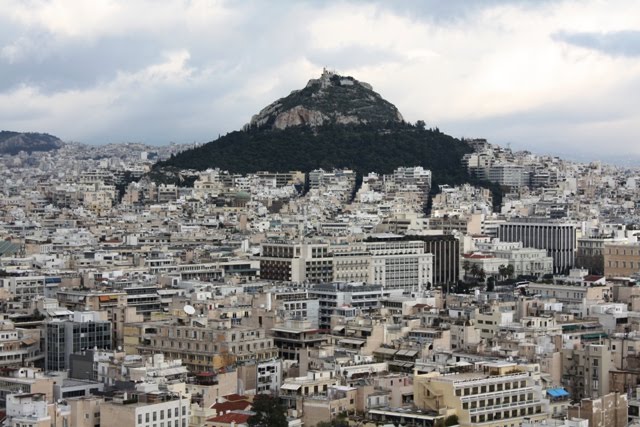 Lycabettus hill is a Cretaceous limestone hill in Athens that rises 277 meters above sea level. The hill is a popular tourist destination and can be reached by a car or by a long and winding walk. But the best thing to ascend the hill is by the use of spectacular funicular railway inside the tunnel that climbs the hill from the lower terminal. Whatever way one prefers, there is a reward at the top - a 360 degree view of the city below. The hill caters an open air theatre and restaurant, and on its peak is a 19th century chapel of St. George. (Athens, Greece / 2011)
17 April 2011
The Pantheon
 The Pantheon is cylindrical in shape and is roofed with a dome. The facade is designed with rows of huge granite corinthian columns. The top of the dome has a large opening which is the only source of light. At 43.4 meters, the height of the dome and the internal diameter of the structure are the same. It was originally built as temple of pagan gods, but was later converted into church. The building now contains the tombs of famous artist Raphael and some of Italian kings. With its ecclesiastical interior design and geometic pattern, it became one of the best preserved buildings in Rome. (Rome, Italy / 2009)
10 April 2011
Spanish Steps
 Spanish Steps or Scalinata della Trinita dei Monte is a monumental stairway in Rome that stands at the steep slope between the Piazza de Spagna at the bottom, and the church of Trinita dei Monte on top. At the base is the early Baroque fountain, called Fontana della Barcacia. Completed in 1725, the steps formed a symbolic link between the king of Spain whose embassy was laid at the base of the hill, and the catholic church papacy which had been stationed in Rome. Designed with 138 steps which gradually widen down the hill in the shape of a fan, the staircase is the widest in Europe. Nowadays, it is a popular tourist spot in Rome. (Rome, Italy / 2009)
05 March 2011
Arc de Triomphe
 Arc de Triomphe stands at the center of Place de Gaulle on the western end of Champs Elysees in Paris. It stands 50m in height, 45m long and 22m wide. The monument has two vaults. Beneath its vaults lies the "tomb of unknown soldiers" from World War I. It also honors those who fought and died for France in the French Revolution and Napoleonic wars, with the names of all French victors and generals inscribed in its surface. The arch is the second triumphal arch in existence and is one of the most famous monuments in Paris. (Paris, France / 2010)
27 February 2011
Chateaux de Versailles


The castle is one of the most visited chateaux in France and one of the largest palaces in the world. It is the grand example of French architecture. The castle has over 2000 windows, 700 rooms, over 1200 fireplaces, 67 staircases. In 1789, this magnificent palace was converted into museum of French history. Aside from the "Hall of Mirroros" and the lavishly decorated King's bedroom, the museum also caters paintings, sculptures, tapestries and furnitures. The Versailles garden has 1300 units of fountain which uses water coming from the Seine River. (Versailles, France / 2010)
20 February 2011
Place de Concorde
 This 8-hectare Place de Concorde is the largest public square in Paris. Originally named Place Louis XV, the square was designed originally for the purpose of showcasing equestrian statue of the king. The construction of the square began in 1754 and was completed in 1763. Several decades after its construction, the square became a focal point for the bloodiest French revolution. Following the revolution, the square suffered several transformations and changes of names until it was finally called Place de Concorde - symbolizing the troubled era and the hope for a better future. In the middle of the square is a more than 3200 year old obelisk, standing 23 meters tall, weighing more than 220 tons and is covered with heiroglyphs. (Paris, France / 2010)
Subscribe to:
Posts (Atom)